

A Guide to Successful Onboarding and Expectation Setting
As the leader and visionary of your business, bringing a virtual assistant (VA) onboard is an opportunity to enhance productivity and focus on what truly matters—scaling your business.
While VAs are skilled professionals who can manage everything from administrative work to complex tasks like marketing and IT, their success is largely dependent on the clarity of expectations and structured onboarding.
You, as the business owner, need to set the tone from the start to ensure a smooth working relationship.
This guide will walk you through how to successfully onboard your VA, set expectations, and create a framework for deliverables.
1. Onboarding Your VA: Setting the Foundation
Onboarding is the first critical step in establishing a productive working relationship with your VA. A well-structured onboarding process ensures your assistant understands the culture of your business, your objectives, and the tools they will use.
What to Include in Onboarding:
- Introduction to Company Values: Share the mission, vision, and core values of your business.
Benefit:
This will help your VA align their work with the larger goals of your business.
- Overview of Tools: Whether it’s project management software like Asana or Trello, communication platforms like Slack, or specific tools for tasks, ensure your VA is trained and comfortable with these from day one.
Tip:
Provide resources or offer to have another team member to walk them through.
- Access to Resources: Provide access to any necessary documentation, brand guidelines, or previous examples of completed work so they can understand your expectations clearly.
Pro Tip: Make the onboarding process interactive by holding video calls to explain tools and processes.
Benefit:
Builds rapport and ensures real-time clarification.
2. Setting Expectations: Clear and Early
One of the biggest mistakes in hiring a VA is failing to set clear expectations upfront. As the leader of your business, you need to communicate your goals and what success looks like.
The clearer you are, the more likely your VA will meet—and even exceed—your expectations.
What to Clarify:
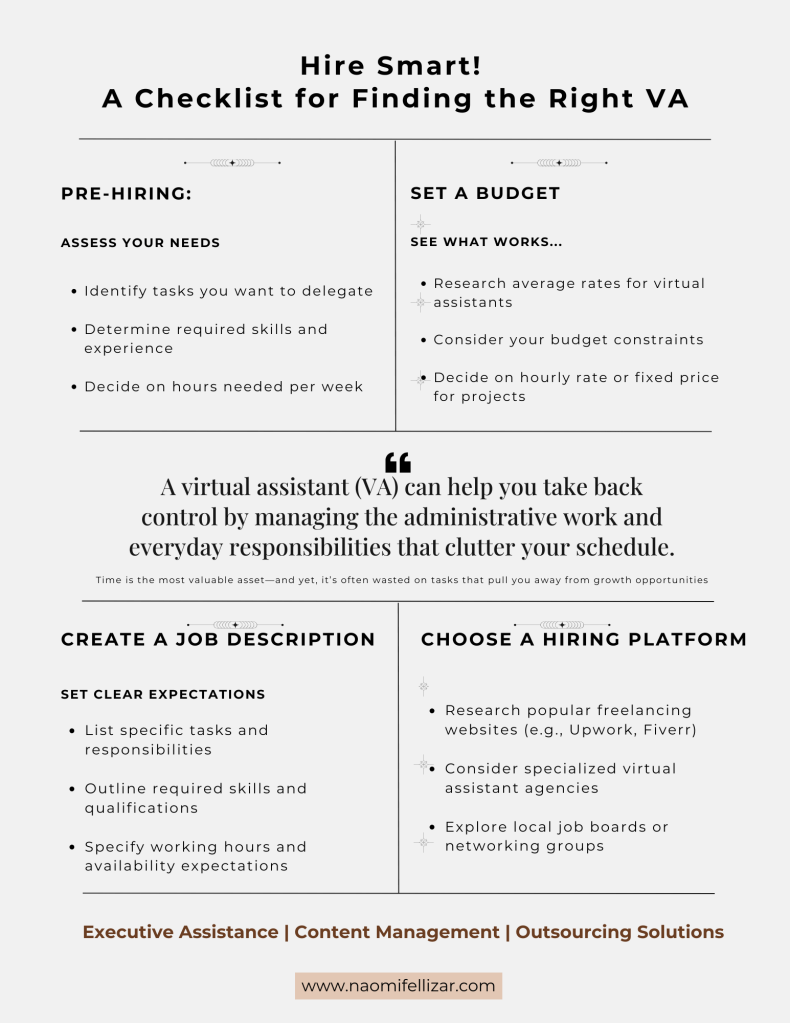
- Task Scope: Be specific about the tasks you expect your VA to handle.
It can look like:
Daily responsibilities (e.g., managing emails, scheduling) as well as long-term projects (e.g., social media management, market research).
- KPIs and Success Metrics: Define what success looks like. For example, “Answer all customer service emails within 24 hours” is a measurable goal, whereas “improve customer service” is vague and harder to track.
It can even be just a simple task list like creating a blog, sending in x number of emails, the important thing is that it is concrete so it can be measured.
“If you can’t measure it, you can’t improve it.” – Peter Drucker
- Communication Expectations: Establish how often you expect updates and through which channels.

When choosing a quality VA:
Evaluate Communication Skills Early
Tip: Assessing communication skills during interviews to avoid misunderstandings and build a strong working relationship with your VA from the outset.
Clarify if:
Should they send daily status updates via email, or are weekly video calls more appropriate?
Pro Tip: Create a task list or a job description that breaks down each duty. This gives your VA a point of reference and ensures they always know what’s expected of them.
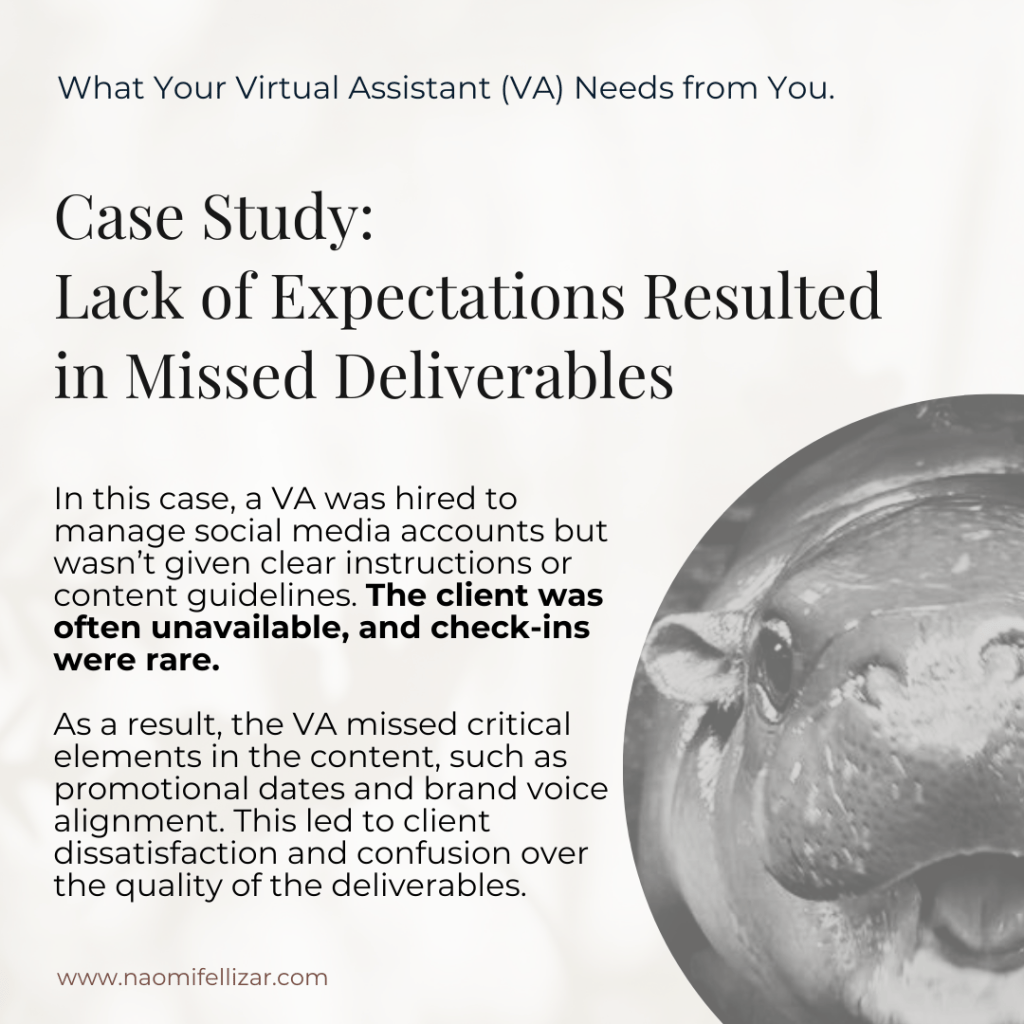
Without guidance, VAs can misinterpret tasks, deliver work that doesn’t align with business goals, or overlook important details.
3. Creating a Framework for Deliverables
Once expectations are set, it’s important to provide a clear framework for how deliverables will be tracked and managed. This helps maintain accountability while providing your VA the autonomy to excel.
Building the Framework:
- Deadlines and Timelines: Set realistic deadlines for all tasks and projects. Use a shared project management tool to track these deadlines and ensure transparency.
- Deliverable Quality Standards: Provide examples of past work or templates that demonstrate the level of quality you expect.
For example, if your VA is handling content creation, share previously published blog posts as reference points.
- Feedback Loop: Set up a process for regular feedback. Whether it’s bi-weekly check-ins or a formal monthly review, provide constructive criticism and positive reinforcement.
Benefit:
This not only helps your VA improve but also ensures they feel valued.

Having a system ensures your VA is always on the same page with the team.
Pro Tip: Use collaborative platforms like Google Drive or Dropbox for shared documents. You can leave comments directly on the work for easy feedback.
4. Setting the Tone
As the business owner, it’s important to recognize that how you lead your VA directly impacts their performance.
Successful VAs thrive under leaders who are clear, supportive, and communicative. Your tone sets the stage for the working relationship.
Ways to Lead Effectively:
- Be Accessible: Make yourself available for questions, especially during the first few weeks, so you can build trust and prevent misunderstandings.
- Empower Your VA: While providing clear instructions is important, also empower your VA to make decisions within their scope.
This will promote a sense of ownership and accountability. If you are not yet comfortable, allow small decisions until you can trust them enough.
- Celebrate Wins: Acknowledge successes, no matter how small.
Benefit:
This boosts morale and encourages your VA to continue delivering high-quality work.
Pro Tip: Remember, your VA is not just a task-doer but an extension of your business. Treat them as part of the team, and you’ll see a stronger, more motivated assistant.
5. The Road to Long-Term Success: Consistency is Key
Working with a VA is not just about short-term gains; it’s about planting a long-term, mutually beneficial relationship. Regular communication and consistent expectations will ensure your VA continues to perform at a high level.
Tips for Long-Term Success:
- Regular Check-Ins: Schedule consistent touchpoints (weekly or bi-weekly) to discuss ongoing tasks, upcoming projects, and any challenges the VA may be facing.
Imagine leaving your virtual assistant (VA) to create posts for an account they haven’t directly handled before. Without regular check-ins, there’s a high chance that they may miss key details or misunderstand the client’s expectations, leading to posts that don’t align with the client’s brand or goals.
- Adapt and Grow: As your business evolves, so should your VA’s role. Offer additional training or assign new responsibilities to help them grow alongside the business.
As an experienced virtual assistant, I have always remembered clients who sponsored any training, it’s a compliment to potential and makes me work harder to express my gratitude and appreciation.
- Compensation and Recognition: Acknowledge their hard work and consider bonuses or salary increases for outstanding performance.
Pro Tip: Keep an open mind and listen to your VA’s feedback. They may have insights or suggestions that can improve processes, especially if they’ve worked in various industries or roles.
The Bottomline:
You Are the Leader
At the end of the day, your virtual assistant is there to support your business, but the success of the relationship starts with you. By leading with clarity, structure, and open communication, you set the tone for a productive and rewarding working relationship. You don’t hire a graphic designer and expect them to bring in investors, do you?
Remember, investing time upfront in properly onboarding your VA and setting clear expectations will pay dividends in the form of increased efficiency, cost savings, and, most importantly, more time for you to focus on scaling your business.
Are you a VA and you have a situation?
Send me a message and I’ll answer it on the end of my articles.
Concern:
I am a VA my client hasn’t paid me and is not communicative, he is not providing me instructions or assurance, its been 2months, how can I initiate communication to a person who is not even on top of his business?
In a situation where your client hasn’t paid you for two months and is unresponsive, it’s important to handle communication professionally while asserting your boundaries.
Here are my recommendations on how to approach the issue:
1. Send a Formal Reminder
Start with a clear, polite, and direct email addressing the outstanding payment and lack of communication. Be firm but professional in your tone.
As a beginner, you may have worked with simple verbal agreements before. However, it’s important to make it a habit to have a written agreement in place for every project. This will help avoid confusion and serve as documentation of each party’s responsibilities and limitations
Example Email:
Subject: Follow-up on Pending Payment and Project Updates
Hi [Client’s Name],
I hope you’re doing well. I wanted to follow up on the outstanding payment for the past two months of work. As per our agreement, payments were due on [when]. Unfortunately, I have not received payment, and I haven’t been able to get updates from you regarding the project’s progress or next steps.
It’s important for us to resolve this matter so I can continue delivering the high-quality work you expect. Could you kindly confirm when the payment will be made? Additionally, I would appreciate it if we could reconnect to discuss the next steps for the project.
I value our partnership and look forward to resolving this smoothly. Please let me know a convenient time for us to have a brief discussion.
Thank you for your attention to this matter.
Best regards,
[Your Name]
2. Reiterate the Agreement
If the client does not respond, send a follow-up email referencing the terms of your contract (if one exists) to remind them of their obligations.
Make sure to provide evidence of the work completed, if necessary, and reiterate the importance of communication for the project to move forward.
Follow-up Email:
Subject: Urgent: Final Reminder for Payment and Communication
Hi [Client’s Name],
I am writing again to follow up on the payment that is now overdue by two months. According to our agreement, payments should have been completed by [due date]. To date, I have not received the payment or instructions to proceed.
For clarity, attached is a summary of the work completed and the agreed payment terms. If I do not receive a response by [insert deadline, e.g., one week], I will need to pause all further work until the payment is settled.
I understand things may be busy on your end, and I’m happy to adjust the timeline for the project, but I need confirmation and settlement of the outstanding payment.
Please let me know when we can talk.
Thank you,
[Your Name]
3. Offer a Grace Period or Resolution Option
If the client is struggling to make payments due to unforeseen circumstances, you could offer a payment plan or another form of resolution, demonstrating flexibility while still asserting your boundaries.
Compassionate Message:
Hi [Client’s Name],
I understand that things can get hectic, and if there are challenges preventing timely payment, I am open to discussing a flexible arrangement. Please feel free to share any concerns or propose a schedule that works for you.
Looking forward to hearing from you,
[Your Name]
4. Set a Final Deadline
If the client remains unresponsive after multiple attempts, set a final deadline for payment and communication. Clearly state the consequences if the deadline is not met (e.g., pausing work or seeking external resolution such as legal assistance).
Final Notice:
Subject: Final Notice: Outstanding Payment and Next Steps
Hi [Client’s Name],
This is my final attempt to reach you regarding the unpaid invoice for the work completed over the past two months. If I do not receive payment or a response by [final deadline], I will have to pause all further work and may need to escalate this matter.
I hope we can resolve this professionally and continue working together.
Best regards,
[Your Name]
5. Know When to Walk Away
If the client still doesn’t respond after the final notice, you may need to decide whether to pursue legal action (depending on the amount owed and your contract) or walk away to avoid further stress.
If the amount is small, it may not be worth escalating. However, always consider your mental health and the value of your time when deciding whether to continue working with difficult clients.
Important To Know:
- Document everything: Keep records of all communication, invoices, and completed work.
- Seek legal advice: If the payment is substantial, consult with a legal professional about your options.
- Stay calm and professional: Emotional responses can escalate situations unnecessarily. Keep your tone assertive yet professional throughout.
Approaching the situation with clear communication and professionalism helps protect your interests while giving the client every opportunity to resolve the issue.
 naomifellizar