

The Philippines Emerges as an AI-Driven Workforce Leader
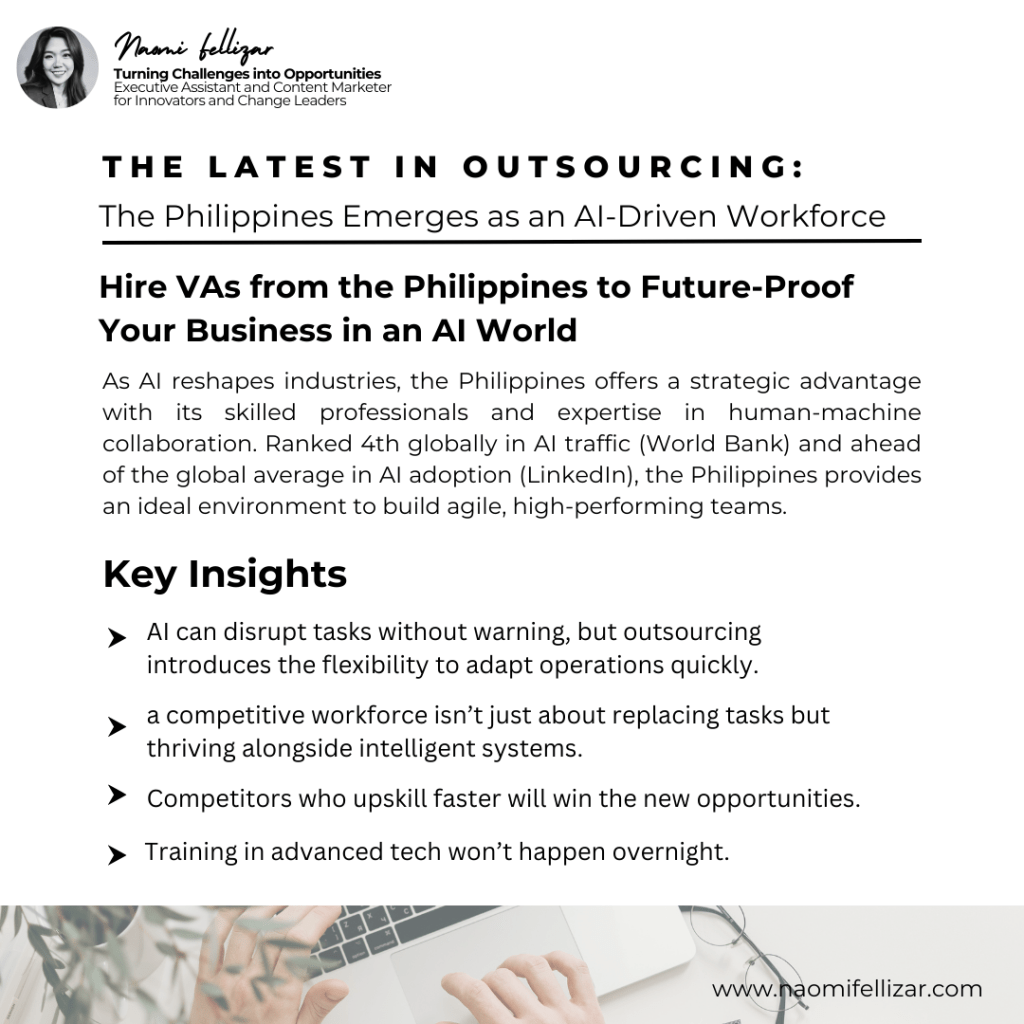
As AI reshapes industries worldwide, the Philippines stands out as a prime destination for outsourcing services, thanks to its skilled workforce and growing interest in human-AI collaboration.
The country is ranked 4th globally in AI-related traffic (World Bank) and surpasses the global average in AI adoption (LinkedIn), positioning itself as a future-ready outsourcing hub.
In 2024, the country’s outsourcing sector is projected to generate nearly $40 billion in revenue, employing 1.82 million workers. Additionally, over 1.5 million Filipinos provide freelance services through platforms such as UpWork and Fiverr, further strengthening the country’s global outsourcing influence.
Jack Madrid, president of the Information Technology-Business Process Association of the Philippines (IBPAP), acknowledges that while AI-driven automation is displacing some roles, it is also creating new opportunities. “The Philippine IT-BPM industry acknowledges the challenge and opportunity presented by GenAI,” Madrid explains, noting that AI tools can boost productivity by 14%, particularly for newer employees, enhancing customer service and operational efficiency.
To adapt, the industry has prioritized upskilling and cross-training programs to ensure that Filipino workers remain relevant in an AI-driven economy.
To adapt, the industry has prioritized upskilling and cross-training programs to ensure that Filipino workers remain relevant in an AI-driven economy.
As AI automates routine tasks like data entry and basic customer support, the demand for more advanced technical skills—such as machine learning and AI system management—is growing.
Recognizing this shift, the IBPAP has partnered with educational institutions to integrate AI training into workforce development programs, helping businesses leverage the best of both AI and human expertise.
By outsourcing to the Philippines, businesses can achieve cost-effective growth, 24/7 operational coverage, and access to a tech-savvy workforce, ensuring businesses stay competitive while mitigating risks associated with AI disruptions. “AI isn’t about replacement—it’s about augmentation,” Madrid emphasizes, emphasizing the importance of collaboration between technology and people in shaping the future of the industry.

Filipinos are leading globally in AI adoption, with 86% of knowledge workers integrating AI into their work routines, surpassing the global average of 75% and the regional average of 83%
As the industry evolves, early adopters of outsourcing in the Philippines will gain a significant competitive edge in the global economy.
Sources: Manila Standard, Philstar, Asia Pacific Foundation.
 naomifellizar